The information contained herein has been provided to you by UTXO Management, LLC and its affiliates (“UTXO Management”) solely for informational purposes. Neither the information, nor any opinion contained herein, constitutes an offer to buy or sell, or a solicitation of an offer to buy or sell, any advisory services, securities, futures, options, coins or other financial instruments. Nothing contained herein constitutes investment, legal or tax advice or is an endorsement of any of the companies, digital currencies, or coins mentioned herein. You should make your own investigations and evaluations of the information herein, as it may not be independently verified by UTXO Management.
The report was written in collaboration with Will Owens: @owenswill14.
Key Takeaways
- Stablecoins started on Bitcoin. They are now coming back to Bitcoin thanks to a technological renaissance — and the market is not paying attention.
- If Bitcoin stablecoins grow at a similar rate to crypto stablecoins, we estimate they could capture between $108B – $483B in market cap by 2030.
- As institutional demand for Bitcoin yield grows, Bitcoin-native stablecoins are poised to become an appealing solution for companies and funds holding significant Bitcoin reserves.
- The emerging Bitcoin stablecoin ecosystem leverages the core strengths of the Bitcoin network to bring less-centralized alternatives to market. Avalon Labs stands out with $600M TVL, reaching a fourth-place ranking in the CDP sector within one week of launch; Hermetica, Ducat and Yala follow.
- As Bitcoin L2s dominate the Season 2 narrative, we expect their integration with Bitcoin stablecoin projects will bring additional utility to users and serve as a liquidity bridge in an increasingly fragmented ecosystem.
Outline
- Why Stablecoins Should Come Back to Bitcoin
- The Current Opportunity
- The Emerging Bitcoin Stablecoin Ecosystem
- Game Theory and Moon Math
- The Bull Case for Bitcoin Stablecoins
I. Why Stablecoins Should Come Back to Bitcoin
Origins
Stablecoins may now dominate other blockchains like Tron and Ethereum, but it’s crucial to remember where they first took root: Bitcoin.
USDT (Tether)
Launched in 2014, Tether (USDT) was initially issued on Bitcoin via the Omni Layer protocol. This made Bitcoin the first blockchain to host a fiat-backed stablecoin. Tether’s concept was simple but powerful: peg a token to the U.S. dollar, allowing users to move fiat-like assets across blockchains with the security of Bitcoin’s network. However, as Bitcoin’s popularity soared, so did its transaction fees, which made using USDT on Bitcoin costly and slow. Tether eventually migrated to faster, more scalable blockchains like Ethereum and Tron, where lower fees and quicker settlement made it more viable for everyday transactions.
BitUSD
Launched on July 21, 2014, BitUSD was the world’s first attempt at creating a crypto-collateralized stablecoin. It was built on the BitShares blockchain and aimed to allow users to transact in a price-stable currency without relying on centralized entities like banks or fiat-backed systems.
However, this model came with inherent risks that were not widely appreciated at the time. Without any external price oracle, the system relied almost entirely on market psychology and the speculative nature of BitShares itself. The key flaw was the volatility of its collateral — in periods of sharp decline, the collateral became insufficient to support the peg, leaving BitUSD holders exposed. As sell-offs accelerated and BitShares’ price collapsed, the system broke. The lack of a strong redemption mechanism led to BitUSD losing its peg in 2018, from which it never recovered.
Lessons Learned
These early projects offer crucial lessons for today’s stablecoin innovators, especially those building Bitcoin-native stablecoins. While BitUSD relied on a volatile, untested asset as collateral, modern Bitcoin-native stablecoins benefit from Bitcoin’s robustness and liquidity. Bitcoin’s track record as the most secure, decentralized, and scarce asset makes it a far superior choice as collateral. Bitcoin-native stablecoins now have the opportunity to improve upon the original vision of BitUSD by leveraging Bitcoin’s superior security and implementing risk-minimized designs that can withstand periods of market stress.
Bitcoin’s Resurgence
While stablecoins have largely migrated to Ethereum and Tron, the broader market dynamics tell a different story about Bitcoin’s enduring dominance. Bitcoin dominance is rising and ETH/BTC is declining — signaling Bitcoin’s growing strength relative to the broader crypto market.
“89% of BTC — $1.3 trillion in market cap — is completely unleveraged. There’s a huge opportunity to offer BTC-native leverage to that $1.3 trillion.”— Ducat Protocol Docs
II. What’s the Opportunity Size?
Currently, Tether (USDT) and Circle (USDC) command the majority of market share across major blockchains — Ethereum, Tron, and Solana. This section explores the possible TAM for stablecoins, deployment across platforms, and the potential for Bitcoin-native stablecoins to capture meaningful share.
Current Stablecoin Ecosystem
Stablecoins have cemented themselves as the backbone of blockchain activity, with USDT and USDC supply reaching close to $175B. As market fit for stablecoins continues to be proven globally, we expect this market to keep expanding and the dominance of existing players to be challenged.
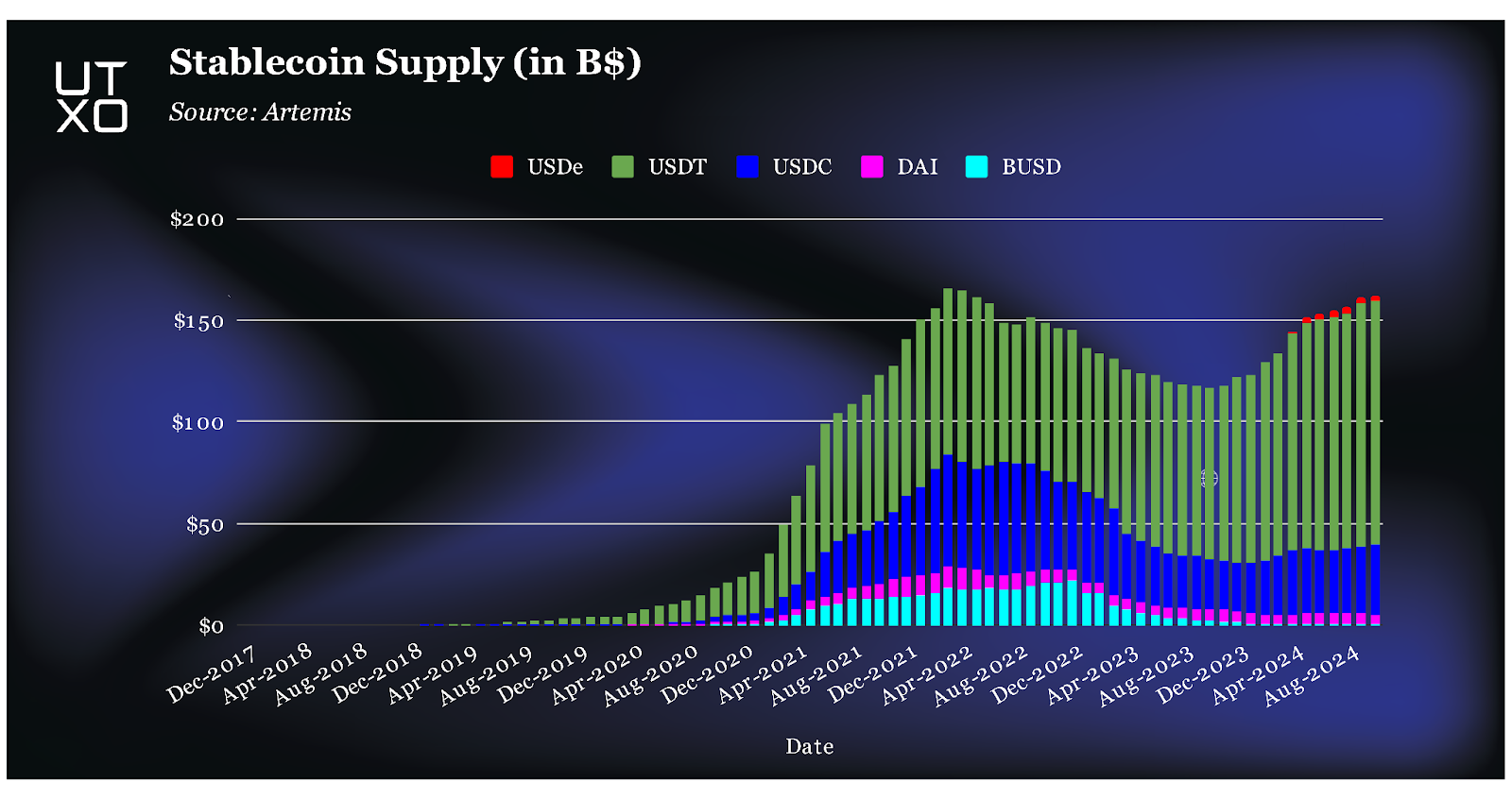
While USDT and USDC have clearly dominated the space, their reliance on centralized custodians presents risks that have not yet been successfully addressed. This sets the stage for the next evolution of stablecoins: a more secure and resilient ecosystem anchored by Bitcoin. Tether alone holds nearly 75% of the stablecoin market.
Stablecoins have, over time, grown to become the majority (~60%) of all blockchain activity — a testament to their product-market fit. Even during Bitcoin drawdowns, stablecoin supplies tend to remain resilient, suggesting an almost counter-cyclical tendency that reinforces our hypothesis: stablecoins are here to stay, driven more by their direct utility than their relationship to crypto markets.
Stablecoin Deployment by Chain
Tron’s adoption in emerging markets has been driven by its low-cost infrastructure, a critical factor in its continued stablecoin dominance. Users in regions such as Asia, Africa, and Latin America prefer Tron’s stablecoin ecosystem for transactions due to its near-zero transaction fees, which make it accessible for individuals and businesses handling high-frequency, lower-value remittances and savings.
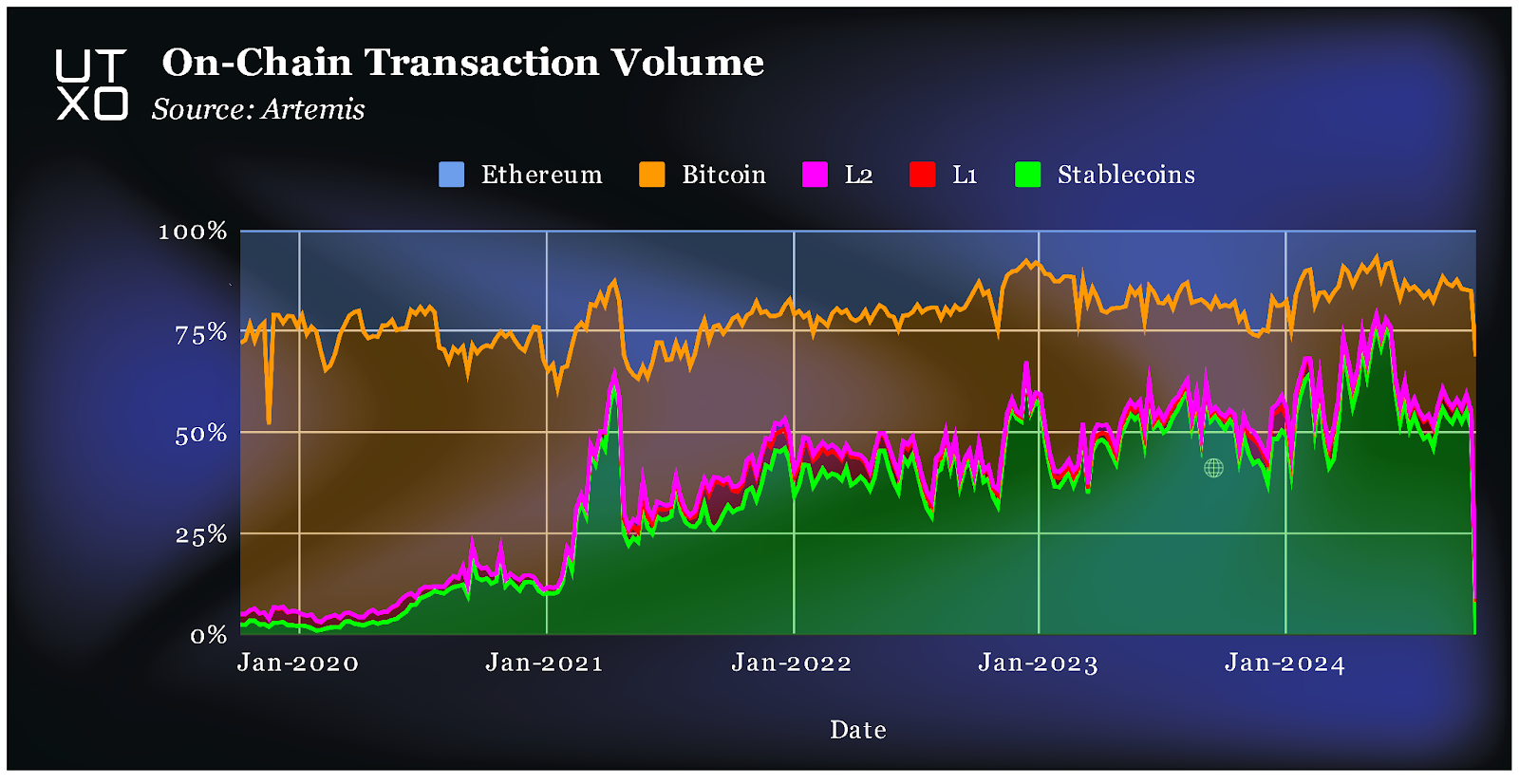
Ethereum and Tron lead by far in stablecoin market cap among the top chains — Ethereum as the DeFi hub, Tron known for speed and cost efficiency. In the last 30 days, the global on-chain volume of stablecoins has exceeded $2.4 trillion, averaging around $80B per day. With growing institutional adoption, increasing regulatory clarity, and improved infrastructure, this volume could soon expand to $3 trillion.
III. The Emerging Bitcoin Stablecoin Ecosystem
Avalon Labs ($USDa)
Avalon Labs is the largest Bitcoin-stablecoin protocol, boasting $600M in TVL. USDa is the core of Avalon’s CeDeFi platform, providing Bitcoin holders with a combination of stability, liquidity, and yield. By using Bitcoin as collateral, users can mint USDa at an industry-low fixed 8% rate. USDa can be converted to USDT 1:1 without slippage on the Avalon CeDeFi lending platform, backed by a $2B CeFi credit line. USDa holders can earn ~15% APY from Avalon’s lending revenues.
Strengths: sustainable yield; extensive DeFi composability; the fixed borrowing rate offers the lowest capital costs, boosting profit margins. Weaknesses: a 60% LTV overcollateralization requirement may limit capital efficiency.
Hermetica ($USDh)
Hermetica is a Bitcoin-native stablecoin protocol that issues USDh, a synthetic dollar backed by Bitcoin and a short perpetual futures position. Users can hold USDh on Bitcoin, earning up to 25% yield, while the peg is maintained through arbitrage and custodians. A Reserve Fund protects against negative funding environments. Hermetica is also very capital-efficient compared to overcollateralized competitors.
Strengths: high yield (also backtested); capital efficiency. Weaknesses: reliance on custodians and complex perpetual futures positions.
Ducat ($UNIT)
Ducat is a Bitcoin-native protocol that issues UNIT, a Bitcoin-backed stablecoin soft-pegged to the USD. It uses zk-proof Bitcoin Ordinal circuits to enable decentralized, permissionless smart contracts without relying on centralized custodians. UNIT is governed by the DUCAT token and maintains stability with a 125–150% collateralization ratio, providing a self-custodial solution for Bitcoin’s untapped stablecoin potential.
Strengths: decentralized, self-custodial solution with high security. Weaknesses: high overcollateralization may limit capital efficiency.
Bamk ($NUSD)
Bamk.fi issues NUSD, a Bitcoin-native synthetic dollar. Phase 1 backs NUSD 1:1 with Ethena’s USDe; Phase 2 will transition to Bitcoin-backed, delta-neutral yield generation through perpetual swaps. BAMK is the governance token, and NUSD holders earn rewards as the protocol shifts to full decentralization.
Strengths: the eventual transition to Bitcoin-backed delta-neutral yields offers decentralized yield. Weaknesses:early reliance on Ethena’s USDe may disincentivize Bitcoin maximalists.
Palladium ($PUSD)
Palladium is a Bitcoin-backed, overcollateralized stablecoin protocol on the Botanix Layer 2 network. It issues PUSD with a minimum 110% collateralization ratio and a 130% system buffer. The protocol is governance-free, relying on preset, immutable parameters. Users mint PUSD by locking Bitcoin into a smart contract and can redeem it for BTC at any time, with fees and arbitrage mechanisms ensuring a stable $1 peg. PDM is a second token that captures fee revenue and offers yield through the stability pool.
Strengths: censorship resistance. Weaknesses:only on Botanix — dependent on that L2.
Yala ($YU)
Yala is a decentralized platform that bridges Bitcoin liquidity across multiple blockchains and issues $YU, a Bitcoin-collateralized stablecoin soft-pegged to the U.S. dollar. Users mint $YU by locking Bitcoin in overcollateralized vaults, allowing them to generate yield through DeFi without selling Bitcoin. Automated liquidation mechanisms ensure system stability, while incentivized Keepers manage price stability through arbitrage and market operations. Yala’s new MetaMint protocol enables direct minting of stablecoins from native Bitcoin without the need for intermediate wrapping.
Strengths: cross-chain Bitcoin liquidity. Weaknesses: complexity of multi-blockchain interactions (operational risk).
IV. Game Theory and Moon Math
Imagine a future where Bitcoin-backed stablecoins reach the same adoption levels as those on Ethereum or Solana. Solana’s $6B peak stablecoin supply was driven by fast transactions and low fees — but Bitcoin offers unmatched security, decentralization, and trust. As the most secure blockchain in existence, Bitcoin-native stablecoins are uniquely positioned for long-term adoption, especially as demand grows for transparent, decentralized financial assets.
If Bitcoin-backed stablecoins capture even a fraction of the stablecoin market on other chains, the potential is immense. With Bitcoin’s dominance and global trust, this could translate into a market cap of $100B or more for Bitcoin-native stablecoins.
Consider Ethereum. It currently supports $80B in stablecoins, despite growing regulatory scrutiny and centralization risks. If Bitcoin-backed stablecoins could match or even surpass Ethereum’s stablecoin market — by a factor of 4, given Bitcoin’s advantages — we’re looking at a potential $400B+ market.
These projections may seem moonbound, but they are not without foundation. The demand for trustless, transparent financial assets is growing. As institutions, governments, and individuals increasingly turn to Bitcoin as a reserve asset, Bitcoin-native stablecoins offer a decentralized alternative to fiat-backed models like Tether and USDC, which are vulnerable to regulation and third-party risks.
The centralization of stablecoin issuance poses significant risks to the broader financial ecosystem. Disruptions like bank failures can trigger cascading liquidity crises. When Silicon Valley Bank collapsed, USDC depegged dramatically — within hours of Circle revealing $3.3B of its reserves were trapped, USDC lost over 10% of its value. Unlike fiat-backed stablecoins, Bitcoin-native stablecoins leverage decentralized reserves, providing resilience to market shocks.
Institutional Adoption and Yield Opportunities
As Bitcoin treasury plays like MicroStrategy (MSTR) continue to accumulate Bitcoin, they will increasingly turn to Bitcoin-native yield opportunities to maximize their holdings. Institutional players seeking stable yield-generating opportunities are likely to explore protocols like Hermetica’s USDh or Avalon’s USDa, which offer up to 15–20% APY through trust-minimized mechanisms. These solutions position Bitcoin-native stablecoins as powerful tools for institutions to earn secure yield on their Bitcoin reserves.
V. Cementing Our Bull Case
We are incredibly bullish on the Bitcoin stablecoin space. The fundamentals are there, the technology is ready, and demand is rising. Bitcoin-native stablecoins will not only capture market share but help redefine the entire stablecoin ecosystem. As Bitcoin becomes the cornerstone of global financial stability, these stablecoins offer a path to a new, decentralized economy — where trust is algorithmic and stability is underpinned by the world’s most secure asset.
Disclaimer: This analysis does not include every Bitcoin stablecoin on the market. For the purpose of this report, we focused primarily on a select group of leading Bitcoin-native stablecoin projects that align with our investment thesis and best illustrate the potential paradigm change being pushed forward by innovative founders.