SOTB_1: An Overview of Bridge Designs for Bitcoin L2s
As we enter a new era of development on Bitcoin, it has become very hard for most people to understand the nuances of the L2 debate, and ever harder to follow some of the technical jargon associated with it. Sidechains, rollups, sequencer, multisig, ZKP… In this report, we’ll try to shed some light on those concepts by outlining the UTXO thesis for Bitcoin L2s and by answering the following questions:
- Does Bitcoin even need bridges?
- What are the differences between sidechains (BOB, Botanix, etc.) and rollup designs (Alpen, Citrea)?
- What are the strategies employed to convince Bitcoiners to bridge their BTC?
- What are the different BitVM implementations and how do they revolutionize Bitcoin bridges?
- Can rollups compete with existing L2 designs such as Lightning?
Table of Contents
- Questioning the Necessity of Bridges
- The Current State of Bitcoin Bridges
- Understanding the Friction Between Solving Technical Challenges and Growing a Sustainable User Base
- The Future State of Bitcoin Bridges (BitVM and others)
- The Thesis for Bitcoin Rollups and Bridge Innovation
Key Takeaways
- Delivering on the promises of Bitcoin Season 2 will require a lot more funding and research into bridge design, blockspace dynamics, and interoperability.
- Sidechains exist on a spectrum and the Bitcoin “L2” category is a victim of ambitious marketing, despite harboring a great deal of innovative new bridge systems that provide a valuable alternative to rollups.
- Rollups are going to be more impactful on Bitcoin than they’ll ever be on Ethereum and have the potential to reach over $133B in TVL over the next five years.
- BitVM and ZKP research is at the forefront of Bitcoin innovation and will become the most important topic of this cycle.
- Investment in companies capable of solving the upcoming problems related to Bitcoin rollups is paramount — including MEV research, data availability, decentralized sequencing, attestation chains, and UX.
I. Questioning the Necessity of Bridges
When we talk about scaling Bitcoin, the same questions inevitably arise to remind us of the scale of the challenge. Among them, the question of whether the Bitcoin base layer should scale was answered long ago during the Blocksize Wars: Bitcoin will have to scale in layers.
Layers, however, are a heterogeneous bunch and many different mechanisms exist to build them. One of the oldest and simplest ways of bringing scale to Bitcoin is sidechains. But sidechains are not technically a true “layer” of Bitcoin since they often lack the unilateral exit component that makes them trustless for users — i.e., with the same trust assumptions as the base layer. That is why, for the many years that followed the introduction of SegWit, the Bitcoin community focused a lot of energy on building the Lightning Network (a true L2 that depends on Bitcoin security to provide users with unilateral exit options) instead of sidechains.
In order for users to join a sidechain, they first have to execute a “peg-in” transaction (or “peg-out” to exit) — basically sending their BTC to an address controlled by the operators of the sidechain. The mechanism securing this system is called a bridge.
The reason bridges are so tricky is that they often rely on a multisignature wallet holding all the sidechain’s funds, and in order to execute withdrawals, users have to trust that a majority within the multisig will cooperate to accept it. For example, a group of 20 companies would set up a bridge contract together, requiring at least 12 companies to confirm a withdrawal transaction. For obvious reasons, this never was an optimized security model — it creates incentives for companies to potentially collude and steal user funds.
A few examples of interesting sidechain designs emerged during that time, such as Liquid (federation of companies) and RSK (merged-mined sidechain), but they never truly succeeded at scale.
Definitions, Courtesy of Bitcoin Layers
Sidechain is an L1 that exists to add more functionality to BTC, the asset. L1s are sovereign in technical architecture but typically exist as subsets of the broader Bitcoin ecosystem. It’s common for sidechains to enshrine a BTC bridge into their consensus mechanisms or involve Bitcoin miners in consensus — through merge mining or fee sharing.
Rollup is a modular blockchain that uses a parent blockchain for data availability. The blockchain stores its state root and enough transaction data to reconstruct the state of the blockchain from genesis in the parent blockchain. Rollups are L2s.
Two-way pegs are systems that facilitate the minting and burning of BTC-backed tokens on a Bitcoin layer or alternative L1. These systems are also known as bridges.
So, if bridge designs have existed for a long time and they haven’t generated a lot of traction, why do we need them now? While Lightning dominated the L2 space for a long time, 2023 saw the introduction of a new idea that would challenge that dominance: BitVM. In a nutshell, BitVM can allow Bitcoin to be more programmable, which could lead to the introduction of new L2 designs such as rollups.
These new designs all rely on an old friend of sidechains: the bridge mechanism that allows users to go from the base chain to the sidechain. However, the promise of BitVM relies on the idea that we could make bridges more decentralized than with traditional sidechains by introducing a challenge mechanism that could punish dishonest actors in a federation.
Therefore, rollups on Bitcoin would not be completely trustless but trust-minimized. You would still need to rely on an honest actor to exit the chain, but this is a trade-off that many users could get comfortable with, given the potential scaling and programmability benefits. BitVM (and Robin Linus) essentially revived the idea of Bitcoin bridges, and brought more legitimacy to them as a way to scale Bitcoin.
Now that we’ve seen why bridges have made a comeback as a legitimate way of scaling Bitcoin, one could still argue that rollups enabled by BitVM will suffer the same fate as Liquid or RSK — a very limited user base. While this could be true, the success of rollups on Ethereum indicates very strong demand from users and a lot of appetite from investors.
The top 10 rollups on ETH have managed to accumulate close to $40B in assets bridged. Arbitrum, Base, and Optimism together have over 71% market share. Over the past year alone, the amount of ETH locked in rollups went from $6.1M to $13.1M — a 114% increase.
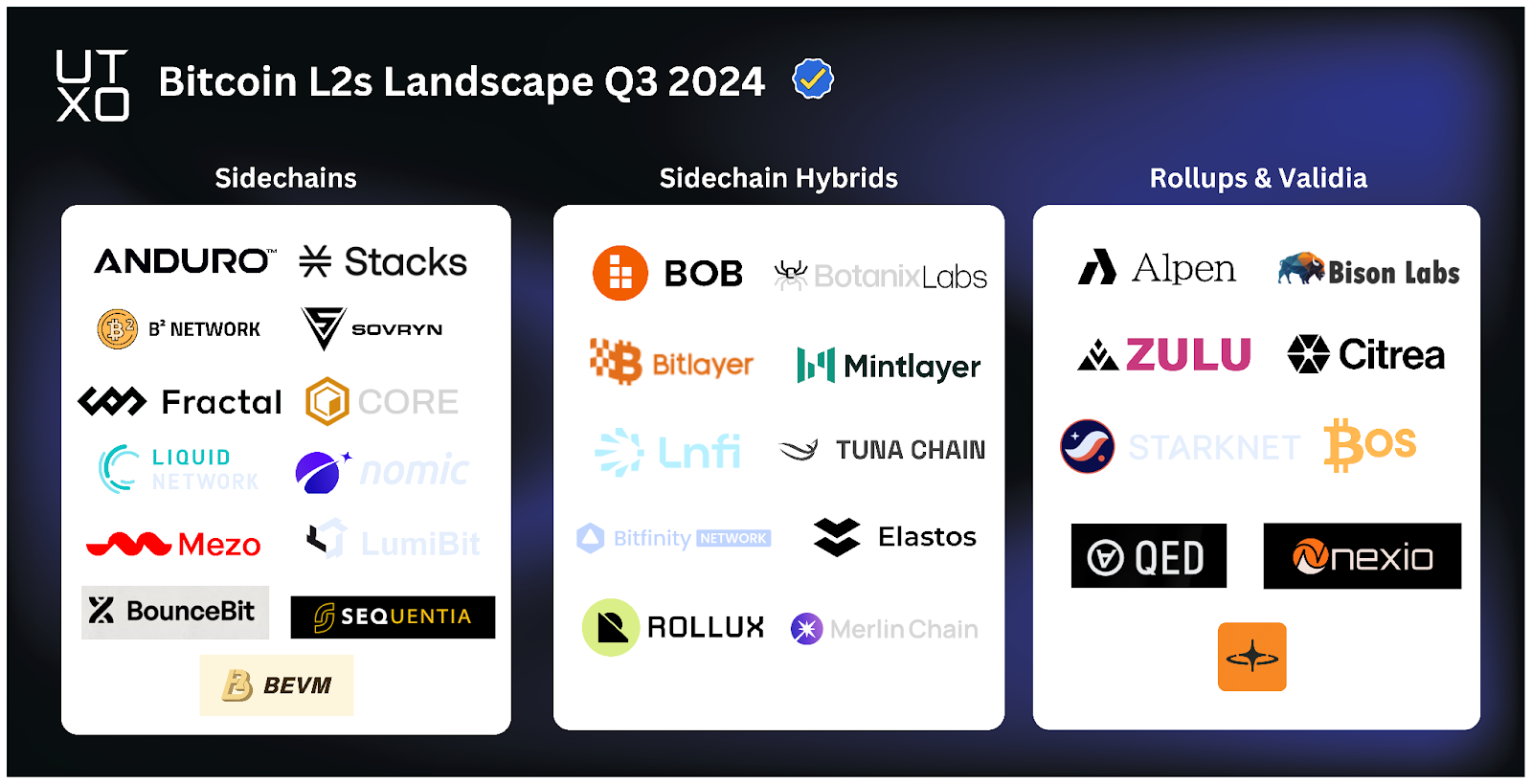
In fact, rollups are going to be more impactful on Bitcoin than they’ll ever be on Ethereum. If we assume the same level of rollup utilization (10.4% for ETH) and take the size of both networks as of July 2024 — $383B for ETH vs $1.276T for BTC — we could make the simple calculation that the total addressable market for Bitcoin rollups could be around $133B. While this number is impressive, one could even argue that Bitcoin will require even more scale than ETH, as it is poised to become the settlement network for all economic applications.
Seeing this potential, a ton of developer mindshare came back to Bitcoin and sparked a true renaissance for the space. Anticipating that Bitcoin users will be interested in bringing more utility to their holdings, sidechains came back in full force at the end of 2023 and the beginning of 2024.
The No-Bridge Meta
Although not the focus of this research piece, it is important to mention that many projects in the L2 space are trying to scale Bitcoin without the need for complex bridge systems. These protocols will play an integral part in the race for scalability on Bitcoin as they provide a valuable alternative for users not willing to make certain trade-offs.
Arch:The Arch Network employs an innovative approach to state management on Bitcoin’s layer 1, utilizing ordinals through a unique “state chaining” process. State changes are committed in a single transaction, reducing fees and ensuring atomic execution. Its novel architecture consists of a two-piece execution platform: the Arch zkVM and the Arch Decentralized Verifier Network.
QED: QED solves the fundamental scaling problem of blockchains by using zk-PARTH, a novel state model which enables massively parallel transaction proving and block generation. This allows QED to scale to millions of transactions per second, while guaranteeing security via proof of math.
RGB++: The RGB++ protocol is not BitVM, even though it can provide native Turing-complete capability on Bitcoin layer 1. It neither relies on new OP codes nor requires hard or soft forks. It also is not an EVM or a rollup, and it does not need a bridge. The RGB++ protocol attaches additional data as an extra program logic to the original Bitcoin UTXO, connecting every on-chain UTXO with off-chain data and extra execution logic.
II. The Current State of Bitcoin Bridges
Now that we’ve established that new bridge designs can be of revolutionary value for Bitcoin as a settlement network, let’s dive into the current landscape of Bitcoin bridges, their architectures, optimizations, and different variants.
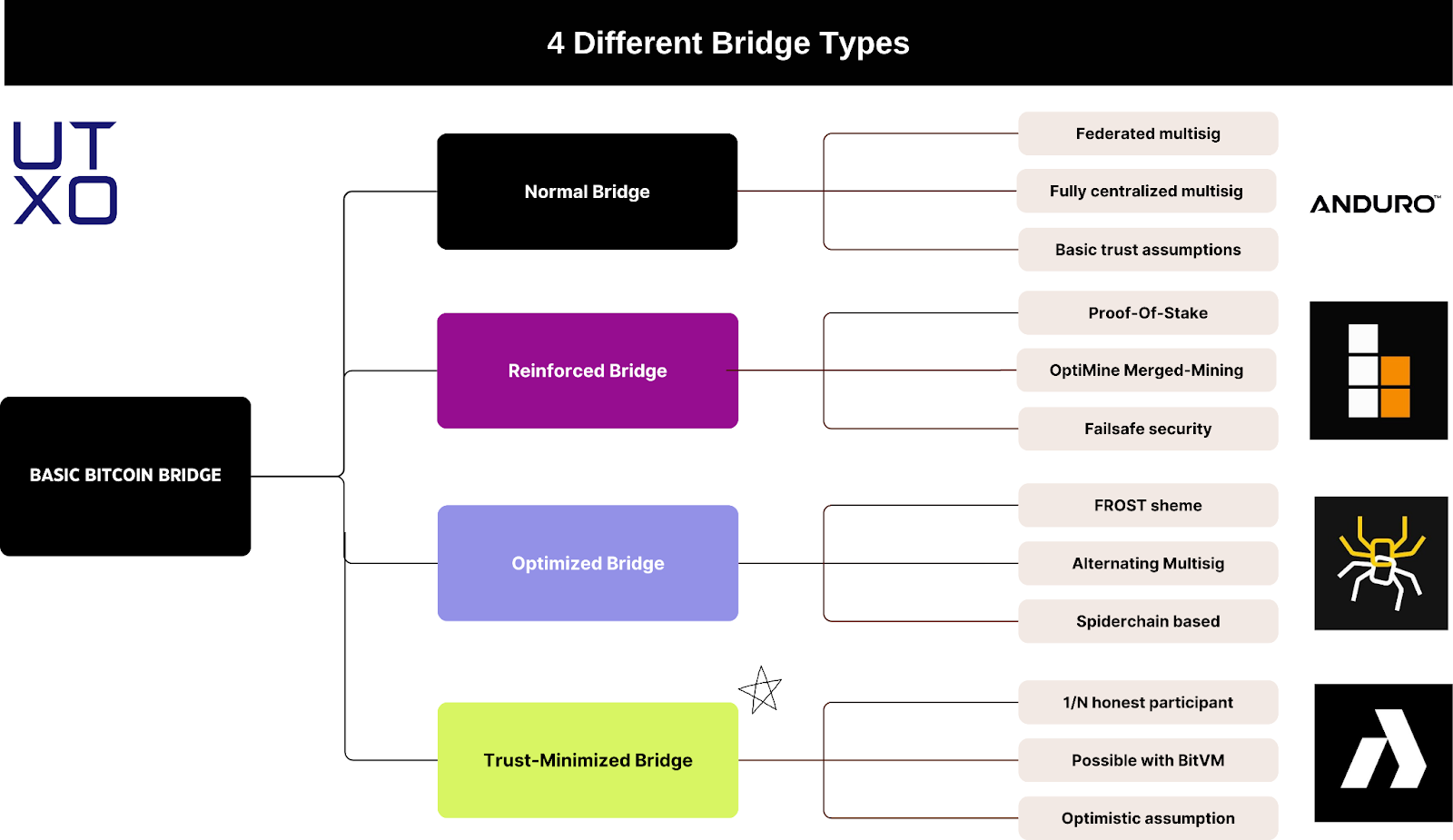
In a nutshell, we can identify four different types of bridge designs:
- Traditional Bridges: Normal bridges as described above.
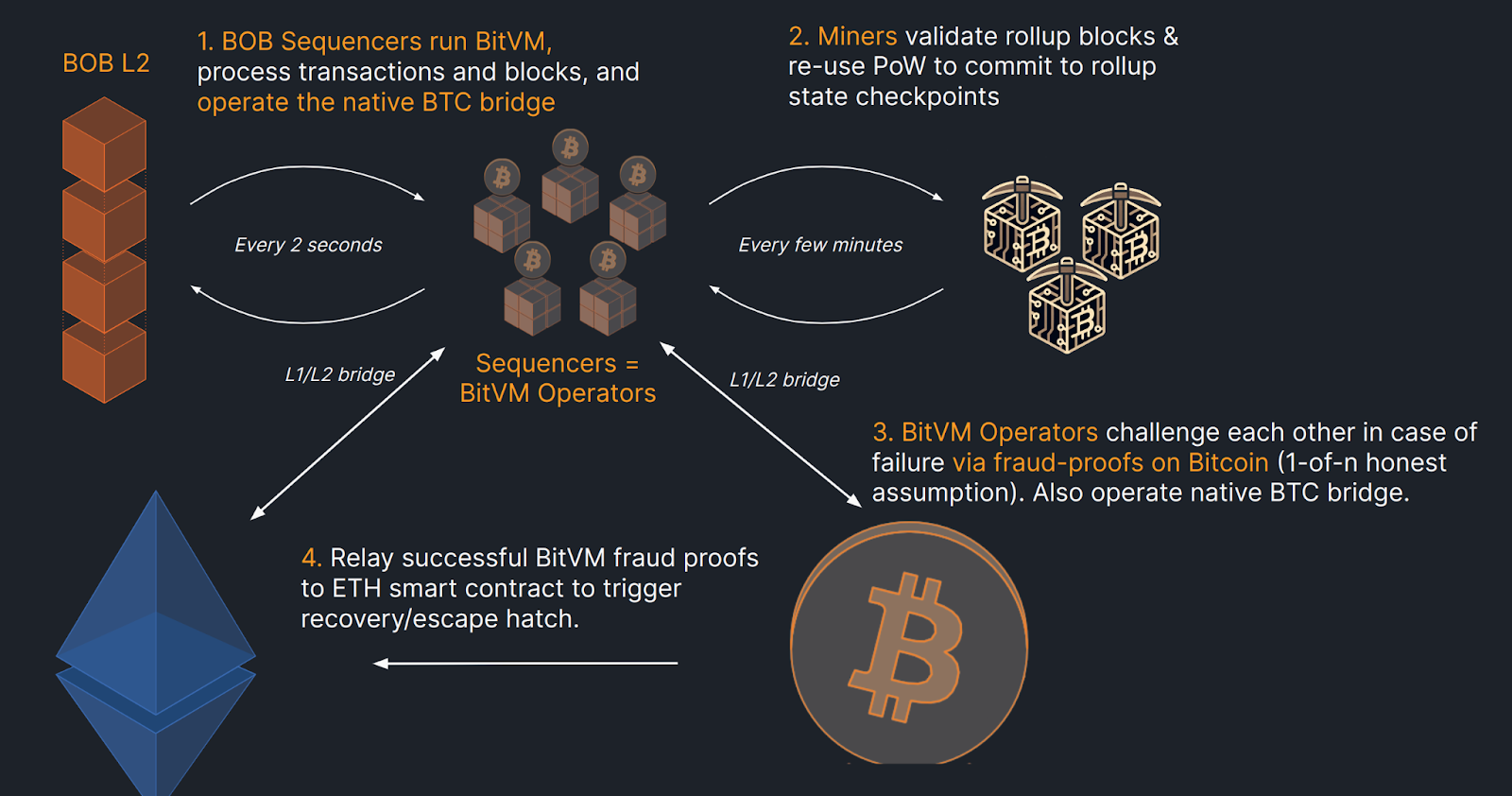
- Reinforced Bridges: Bridge designs that have an additional layer of security added in order to mitigate aspects of the protocol that could be too centralized. In the case of BOB (Built on Bitcoin), phase 2 of the roadmap plans to remove trust in centralized sequencers with Bitcoin miners running full nodes of BOB, thereby verifying that the sequencer is producing valid blocks. This will be achieved using an alternative version of merge-mining called Optimine.
- Optimized Bridges: Bridge designs that innovate by distributing trust among the participants of the multisig. Botanix is a great example — its bridge multisig is constantly distributed among different users and can evolve between blocks. The bridge is also reinforced with a proof-of-stake system complementary to its FROST-based architecture.
- Trust-Minimized Bridges: These bridges are currently being developed by rollup teams and will feature near-trustless assumptions, with the possibility of users even outside the multisig to participate in the protocol.
III. Friction Between Technical Challenges and User Base
For Bitcoin builders in 2024, there are only two options that can make sense in the context of the Bitcoin L2 paradigm:
- Technological approach: focus on the technical challenges of bridging architecture and rollup design to build a trust-minimized layer with complex zero-knowledge proofs and BitVM optimizations.
- Community moat approach: focus on the fastest go-to-market strategy by making calculated trade-offs with bridging architectures and execution environment, hoping to decentralize those once the technology is available. Points or tokens are used to acquire users.
With the community moat approach, the trade-off is simple: sacrifice decentralization in the medium term in order to gain TVL and a solid user base in the short term. While this approach may be criticized by hardcore Bitcoiners, it reflects a business-first mindset that is often lacking in many projects that end up failing despite being technologically superior. Execution is everything.
Sidechains vs Rollups: Being on the Spectrum
That’s really what it comes down to. There’s going to be Bitcoin sidechains, Bitcoin rollups, and everything in between. Bitcoin L2s exist on a spectrum, where the extreme is dominated either by builders going for the technological approach or the community moat approach.
As Janusz from Bitcoin Layers would say, “Not every Bitcoin layer is made equal.” Most people in the space tend to discard companies choosing to focus on the faster go-to-market sidechains approach while admiring the complex work done by BitVM/ZKP researchers.
While we can understand that point of view from a Bitcoin Maximalist perspective, it is a fundamental mistake from a free market perspective. While the technology approach might be more intellectually pleasing, actual users tend to have different priorities. Ultimately, users will decide on their own how to prioritize UX, cheap fees, fast settlement, and protocol security.
At UTXO, we believe that there is value to be captured by both rollups and sidechains, especially if sidechains can deliver on their promises to decentralize over time.
Incentive Programs of New Bitcoin Layers
Point system (BOB): The BOB point system has been by far the most successful iteration of this strategy in the Bitcoin sphere. BOB Fusion is the official points program, where users harvest BOB Spice based on their on-chain activity.
Ecosystem first (Botanix):Choosing not to release a token at launch, Botanix takes an application-first approach. Projects building on Botanix get TVL from day one; speculators’ only way to get exposure to the Botanix launch is to invest in its ecosystem apps.
Research (Bitlayer): One of the most technically advanced teams in the space. Since the early days of BitVM, the Bitlayer team has released a number of extensive research papers on the subject and is actively exploring new ways to improve current BitVM designs.
IV. The Future State of Bitcoin Bridges (BitVM and Others)
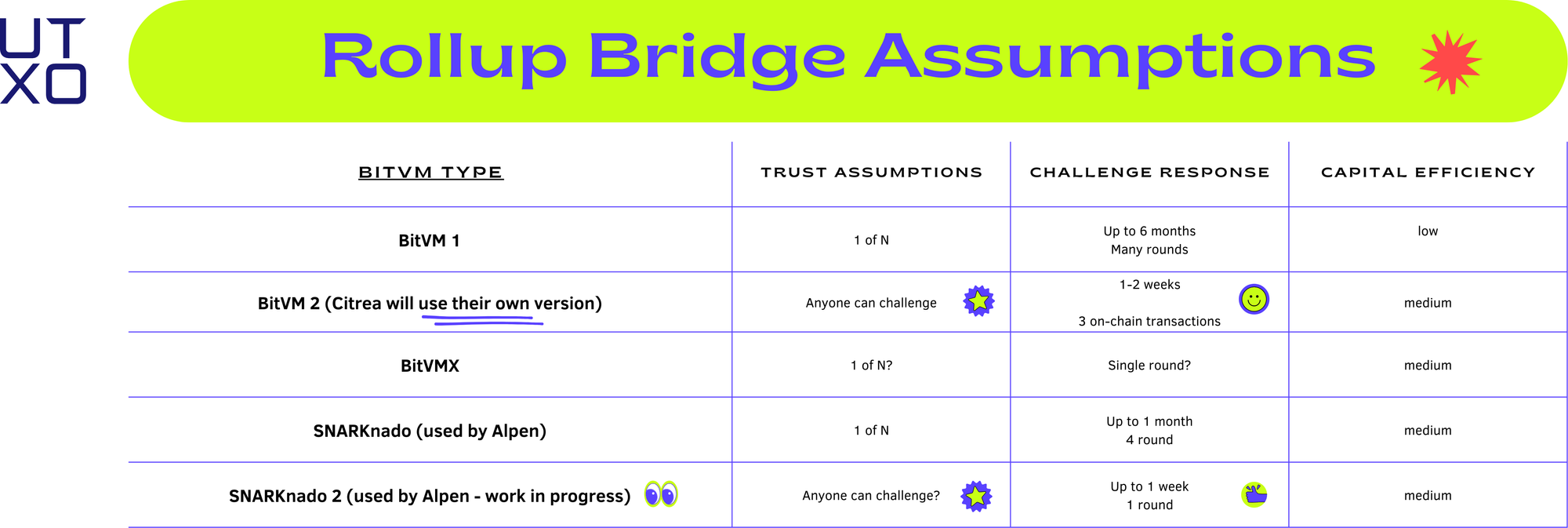
When we look at bridge designs, it becomes apparent that the most decentralized ones will be developed with variations of BitVM. Indeed, BitVM is not a monolithic entity — a few teams are working on competing (and synergistic) adaptations of the initial proposal by Robin Linus.
The main differences in these variations come down to a few key parameters:
- Trust assumptions: What is the level of decentralization of the bridge? Who can challenge the state of an optimistic rollup? Assumptions range from anyone (best) to only a majority of actors in the multisig (worst).
- Challenge response: Once a challenge has been issued, how much time and resources are necessary for “justice to be done”? Assumptions range from months with multiple on-chain interactions (worst) to hours with a single interaction (best).
- Capital efficiency: What are the capital requirements for operators of the rollup? How much BTC do they have to ensure that all users can withdraw funds and make transactions?
“BitVM is not without overhead. Like optimistic rollup, the proof needs a withdrawal period to allow challengers to come in. Notice that a fully on-chain challenge-response can require tens of roundtrips between the prover (Paul) and the challenger (Vicky), and since Bitcoin has a block time of 10 minutes, it can be quite a long time.”— Snarknado whitepaper
“An operator will initially cover user withdrawal requests out of pocket, then aggregate the necessary proofs into a single submission to the network. If other operators suspect foul play, they can challenge the submission. Successful challenges result in the dishonest operator losing their initial bond and being removed from the network.”
The Data Availability Dilemma
One of the herculean choices that teams will have to grapple with is the one of data availability (DA): “the publishing of transaction data which is required to verify transactions, satisfy proving schemes, or otherwise progress the chain.”
There are only two ways of ensuring DA: post it directly to Bitcoin or post it somewhere else. In the case of Bitcoin rollups, by definition, one would expect that DA would always be posted to Bitcoin. However, this is a costly choice that has negative consequences for both user transaction costs and rollup teams’ ability to generate net margins. Some teams have chosen to trade real gains in security for cheaper transactions and additional scalability.
Optimium: an optimistic rollup that stores transaction data on-chain. Ensures availability and security, but increases costs and reduces scalability.
Validium: an optimistic rollup variant that stores transaction data off-chain. Enables high scalability and low costs, but risks potential data censorship or unavailability.
An interesting investment opportunity here is the development of a potential DA layer with a strong relationship to Bitcoin — the Celestia of Bitcoin. This is a big area of focus for UTXO and has in part informed our decision to invest in CHAR by Jeremy Rubin (Bitcoin Core developer, BIP-119 author). CHAR is based on attestation chains where nodes commit to signing a single unconflicted sequence to organize transactions.
Citrea’s Volition Approach
“If you want to deploy a gaming application, you can use off-chain data — very cheap, very fast, but still gets Bitcoin interoperability. If you want to build a Bitcoin-backed stablecoin application, you can use on-chain data so your stablecoin is fully Bitcoin secured. A bit expensive but you still get this interoperability between the gaming application and the stablecoin application.”
Blockspace Demand and Fee Rate Dynamics
Blockspace scarcity will/could lead to centralizing forces for rollups and ultimately for pools. Because of the large amount of data required to settle rollup activity on Bitcoin, rollup operators may be tempted to optimize their transaction flow by using the services of pools — like Marathon with Slipstream. These OOB agreements with miners provide revenue streams not accessible transparently on-chain.
Fee rate dynamics will change with the introduction of another blockspace buyer of last resort. Rollup operators cannot be time-preference aware — their proofs will be submitted at a fixed rate, no matter the fee rate. This agnostic demand is most reflexive on fees, precisely because it competes not just to be included in a block but for the very next block. As utility for Bitcoin as the settlement chain for all economic activity continues to grow, we can expect these types of demand to increase, further impacting fees to the upside.
V. The Thesis for Bitcoin Rollups and Bridge Innovation
In this new landscape of Bitcoin L2s, the competition between sidechains and rollups will be fierce. A common misconception within the space is that sidechains are not interesting because they are more centralized than L2s, and that rollups are just a new form of sidechain.
For sidechains, the bullish case is that bringing EVM compatibility to the Bitcoin ecosystem will spark the resurgence of DeFi activity for Bitcoiners in search of yield opportunities. Over $9.3B is currently locked in WBTC according to DeFiLlama. Bringing this activity back to more Bitcoin-native solutions is imperative if Bitcoin is ever to succeed as a settlement chain for economic activity.
For rollups, the innovation of BitVM can bring them very close to actual Bitcoin L2s, with trust minimization at the core of their designs. Teams leveraging zero-knowledge proofs represent an invaluable opportunity for Bitcoin to increase its scalability while preserving privacy and cryptographic security.
The reason it can be hard for critics to see value in these innovations is what we call the “low fee rate bias.” For years now, Bitcoin fees have been artificially low because its adoption has been slowed by speculation and usage of off-chain exchanges. This bias will rapidly disappear once fees become unbearably high for most users. When this moment happens, we expect sidechains and rollups to become immediate successes as users rush for the exits.
“Thus, I’m at least concluding that, based on our research of sidechains and L2s, Bitcoin benefits from conversations related to improved bridging mechanisms. I believe that the most successful Bitcoin L2s, long-term, will either be supported by a variation of BitVM2, proposed opcode changes, or a combination of both.”— Janusz, Bitcoin Layers
The rise of sidechains is only a consequence of projects trying to front-run what is shaping up to be the biggest narrative for Bitcoin in the coming years — a new narrative that will be accompanied by billions of dollars in new capital. Revolutions are messy, chaotic, and by definition, they tend to surprise the people who are least expecting it. The L2 revolution on Bitcoin follows the same path.