This post aims to outline the investment thesis of UTXO Management.
Why Now?
Three powerful cultural and technological forces are challenging our understanding of Bitcoin as a network and as an asset:
- Bitcoin narratives are always changing, and the introduction of Ordinals and BitVM is changing the way we understand the Bitcoin network.
- The possibility to build on Bitcoin has initiated a brain drain from the crypto ecosystem back to Bitcoin.
- Being early to fuel companies bringing more utility and value to Bitcoin represents a unique opportunity to build a truly decentralized economy.
Bitcoin Narratives Evolve Over Time
If you’ve been in Bitcoin for a while, then you know that narratives tend to change and evolve over time as our understanding of Bitcoin itself evolves. This is a natural part of our collective psyches wrestling to make sense of the ever-evolving catastrophe that is modern economics. When inflation reaches generational highs, we tend to focus more on the absolute certainty that the ever-decreasing issuance of Bitcoin offers; when our governments attempt to restrain our freedom, we tend to focus on the censorship- resistant nature of the blockchain.
A close friend of mine used to say that “Bitcoin is still a teenager” and therefore, we should not be so quick to judge it. Teenagers don’t know who they are — we’ve all been through an identity crisis at some point during those formative years. He’s right. Bitcoin is no different, and — as the collective brain that can conceptualize it — we should be wary of choosing Bitcoin’s final identity so early.
The first thing that comes to mind when attempting to define Bitcoin’s identity is to make a clear distinction between Bitcoin the network and bitcoin (BTC) the asset. BTC is the currency that lives within the network, that is protected by the network (miners and nodes) and that is exchanged on the chain. As an asset, bitcoin is very well understood and its “identity” is not controversial.
More recently, however, much ink has been spilled to settle on what Bitcoin the network should be. And for all the love we have for bitcoin the asset, the most valuable piece of freedom technology that was invented in the last 20 years is Bitcoin the network — its decentralized nature, its clock-like system that gives certainty in the ordering of things, its capacity to send and receive data without permission.
I’ve always been of the opinion that we should consider Bitcoin as a settlement chain for all economic activity, rather than “just” a network to send and receive BTC.
Why? For These Four Simple Reasons
- Suppose we ever want to see BTC adopted as a medium of exchange, a true currency for the world. In that case, we have to create economic incentives to use Bitcoin — to spend it, to invest with it, to use it as the most pristine form of collateral that exists. It already has the biggest network effects, which will never be replicable by other chains.
- Bitcoin the network is the most secure, decentralized, and reliable blockchain that exists. The laws of the free market would therefore dictate that its blockspace is the most valuable commodity among blockchains, which in turn will inevitably increase the demand from rational economic actors to access it.
- The security of Bitcoin relies on miners being financially profitable — we should incentivize all forms of economic activity that would help create a sustainable fee market (without inviting centralizing forces) as block subsidies are cut in half roughly every four years.
- Bitcoin is a permissionless network. As long as you follow the rules set by nodes and pay the corresponding transaction fees, you are welcome to use it. If more people use Bitcoin, it is more likely to become a medium of exchange and harder for governments to attack.
Not so long ago, many criticized Bitcoin for its lack of programmability and conservative approach to governance in opposition to the “move fast and break things” attitude adopted in crypto circles. However, this narrative changed once again with the introduction of Ordinals, competing token standards, and the publication of the BitVM white paper. The same idea that allowed for the creation of the Lightning Network became obvious once again: the Bitcoin network can be the bedrock for a new way of settling economic activity — we just need to build on top of it without changing its core properties.
Since then, the popularity of Bitcoin among crypto developers has skyrocketed as many had the following realization: “What if I could build on Bitcoin now?” For them, Bitcoin became “fun again.”
Why Is UTXO Betting on the Settlement Chain Thesis?
At UTXO, our company motto is “Fueling the companies and technologies striving for hyperbitcoinization,” and our investment thesis revolves around the thesis outlined above: Bitcoin will become a settlement chain that will directly challenge all competing blockchains for fee revenue.
As an investment fund, we have two tools on our belt — money and research. Research helps us identify and shape the narratives emerging on Bitcoin while money helps us fund (on the venture side) and support (on the liquid fund side) the most talented founders aligned with our investment mandate. That’s the “Fueling” part.
Why fueling and not helping? The Bitcoin ecosystem has undergone a radical mutation over the past year with individuals and companies building the engine of the settlement chain — they just need the fuel to power the true explosion of innovation happening within those combustion chambers. In order for the settlement chain to be successful, you need new scaling technologies and innovative companies. Who is building that future now?
The Burgeoning Bitcoin Ecosystem
Creating a successful financial ecosystem on top of a blockchain always faces a fundamental issue: is DeFi a matter of products or infrastructure? In this section, we’ll explore some of the companies building exciting new Bitcoin verticals and promising technological innovations that will help to make those verticals more efficient.
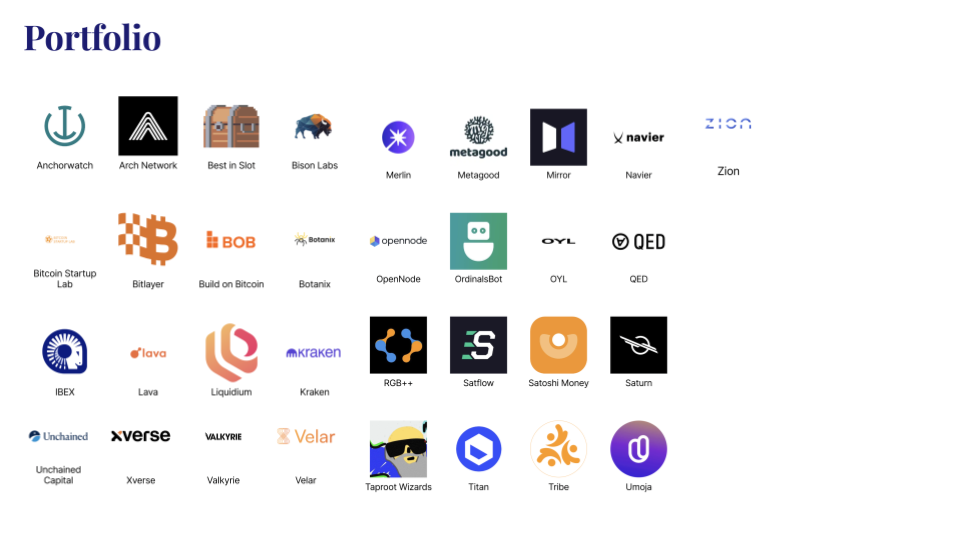
When we look at our portfolio today, we can outline three broad categories of companies building on Bitcoin:
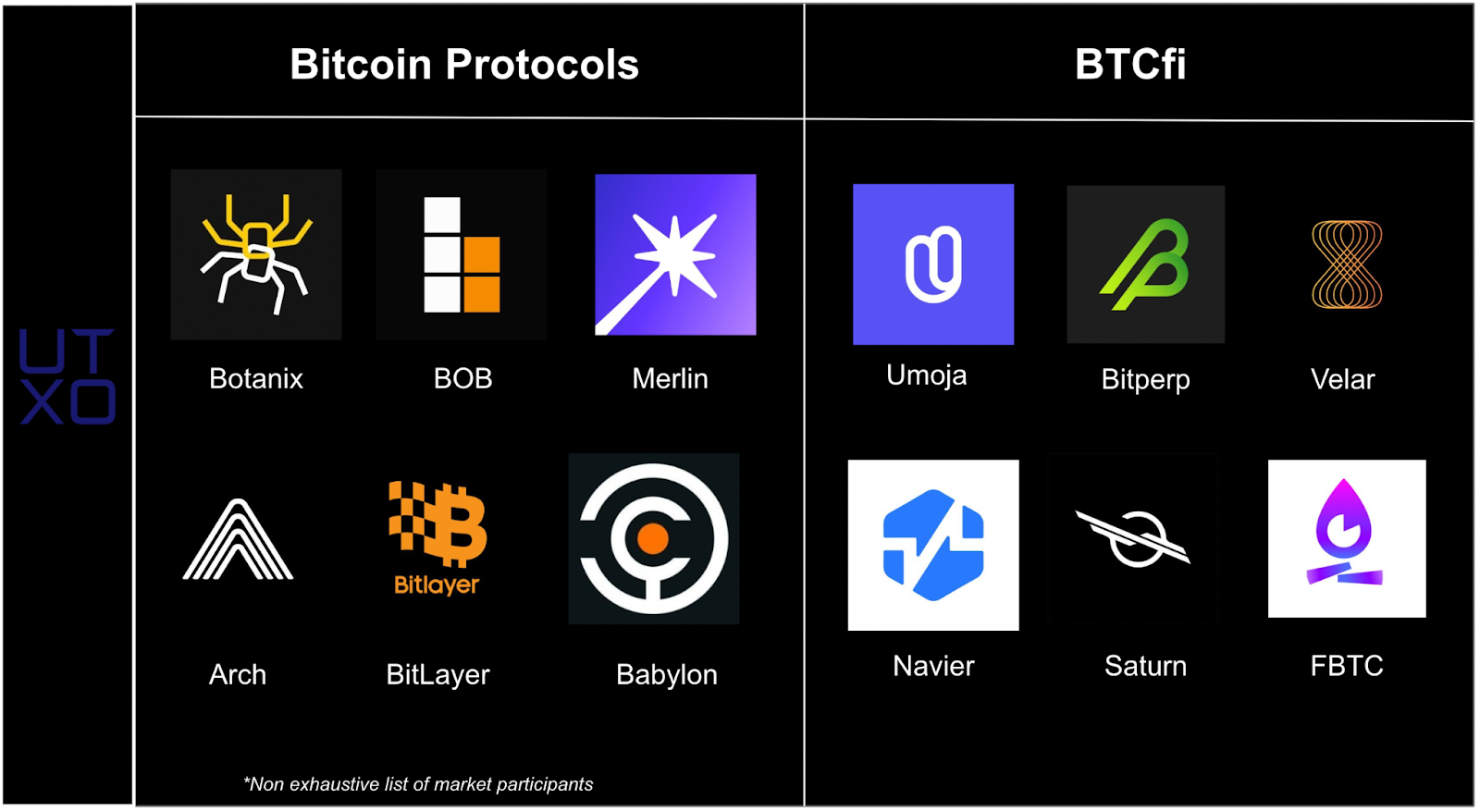
Bitcoin Layers/Protocols & BTCfi: Run It All Back?
Among the most interesting verticals that have emerged on Bitcoin over the past year, Bitcoin layers, protocols, and financial infrastructure are the ones that caught the most attention. The introduction of BitVM challenged the boundaries of “what could be done” on Bitcoin, and as a result, an onslaught of new protocols attempting to become the financial layers of tomorrow have emerged.
The security model and trust assumptions of those companies’ products vary widely, but one thing is for certain — market demand is here. Valuations and TVLs have gone through the roof over the year’s first half as companies rushed to develop new solutions.
In the meantime, every successful product on the market is being recreated on Bitcoin, with new innovative ideas: staking and re-staking on Bitcoin, PoS x PoW shared security, stablecoins, yield vaults, AMMs, hashrate derivatives… the list goes on. Will these new products eat market share away from other chains? Or will they unlock a massive wave of dormant Bitcoin liquidity waiting for years to be deployed? Tune into Bitcoin land later this year to find out.
Bitcoin Infrastructure and UX: First Principles
In crypto, UX is often the determining factor between a successful product and a forgotten one. That is why we have decided to invest in companies like AnchorWatch, OYL, Lava, and others. Infrastructure companies are the bedrock of a solid ecosystem, but those on Bitcoin need to catch up in order to reach the same levels of experience that the ones in other ecosystems can provide. Wallets and reinforced custody solutions are among the most critical pieces of infrastructure necessary today, especially as the fragmentation of liquidity and token standards forces users to interact with many different tools.
King of the Hill: Defining a Token Standard for Bitcoin
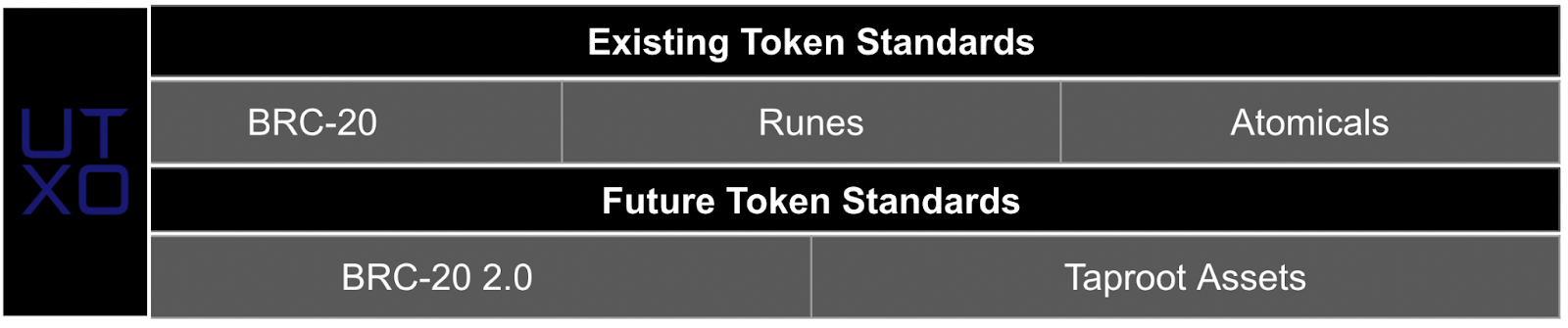
Ever since Ordinals were introduced to Bitcoin, multiple token standards have emerged with the hope of providing an attractive competitor to ERC-20s — first with BRC-20, then CBRC-20, and finally Runes. Because Bitcoin lacks programmability at the script level, developers have had to find innovative ways to go around it, either by building metaprotocols, leveraging the OP_RETURN field, or both.
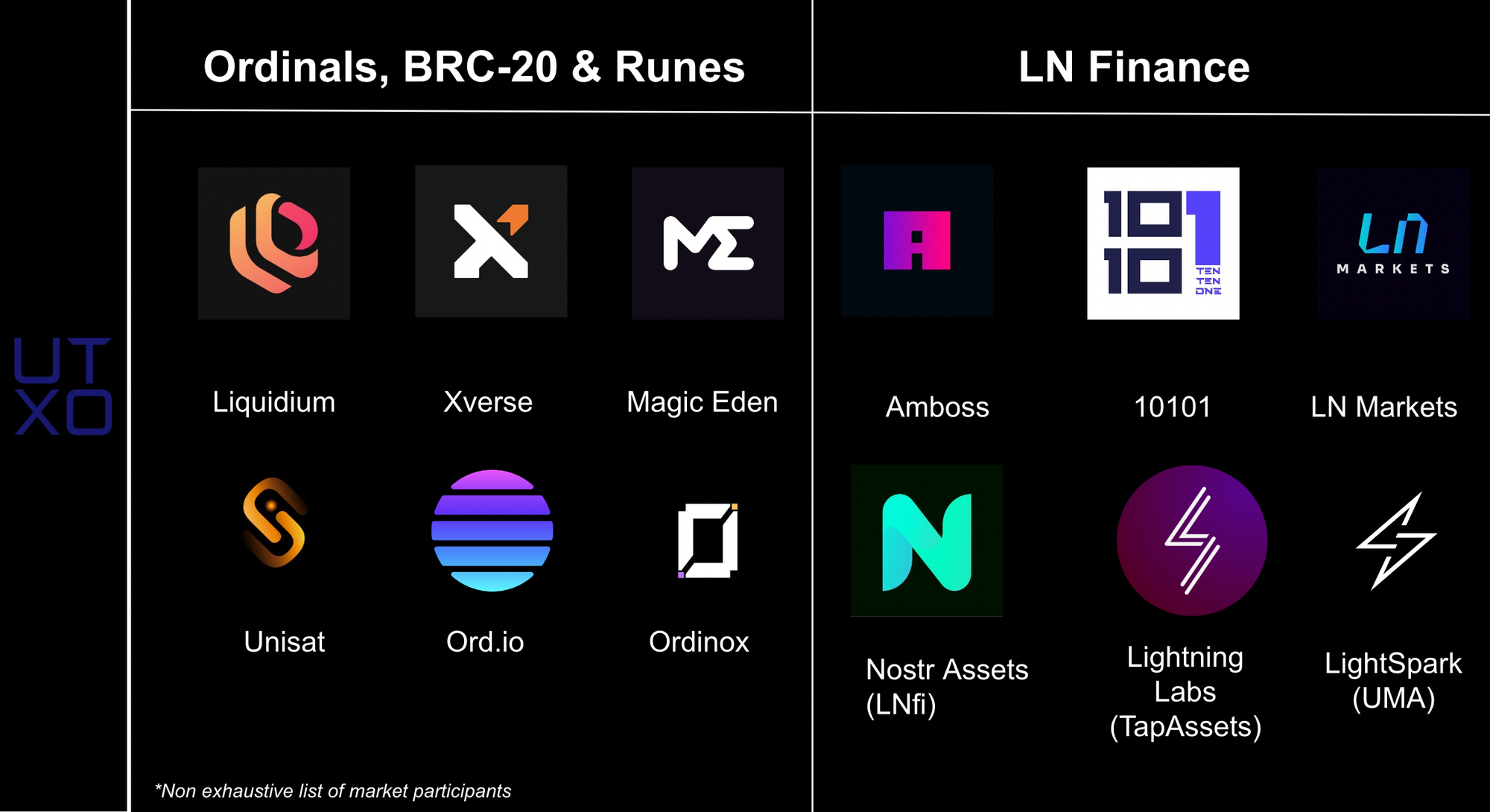
However, most of the existing standards are somewhat inefficient, expensive to exchange, and hard to interact with. Fortunately, many companies are trying to make the experience of trading tokens on Bitcoin more pleasing. We’ve even seen lending protocols like Liquidium give users the ability to leverage their Ordinal assets to generate native BTC yield.
One question remains: which token standard will manage to stick around? As of today, it would appear that Runes are the superior standard, but with the emergence of Taproot Assets, competition will be fierce — especially as the LN finance narrative takes off. Ultimately, if we expect that both standards will be able to be exchanged on Lightning rails (lowering minting and trading costs), community narratives and UX will become the differentiating factors.
We Are Still Early
The Risks and Architecture Trade-Offs
While everything outlined above is exciting, we have to remember that at the time of writing, most of these projects haven’t released their final mainnet products. If history can teach us anything, it’s that innovative ideas are inherently risky, and as Schumpeter once outlined, the process of creative destruction should not be ignored. Mistakes will be made, smart contracts will be exploited, and token prices will crater.
As a venture fund, UTXO is committed to encouraging and helping companies take the necessary steps to mitigate those risks. Our internal research is aimed at helping companies think through design choices and their consequences based on the experiences of the past. Narratives often evolve faster than technology, and the risk preferences of Bitcoin users evolve with them as well. Understanding those narratives is therefore paramount. But narratives are also shaped, and our intent is to help shape the narratives that will benefit the most responsible builders.
In addition to technological risks, reputational risks are greater on Bitcoin than on any other chain. Navigating the complex history of Bitcoin and its many tribes can be complicated, and even confusing. That is why we believe we are uniquely positioned to help builders get their message across chains and communities.
Everyone knows how much the “first-mover advantage” can influence the success or failure of a company. This will lead companies to cut corners to achieve this status, and the most likely victim will be decentralization. Companies move faster than technology.
However, being early is also an opportunity — an opportunity for researchers and analysts to come together and help shape what the path toward decentralization could look like for these companies. Not everything requires complete decentralization, but we at least have a chance to build something different from other chains. Something that is aligned with the ethos and values of OG Bitcoiners.
This is why we are also proud to actively support the Bitcoin Layers project spearheaded by Janusz and Red. It’s often hard for market participants to understand the trade-offs inherent with the products or layers they are interacting with; having a comparative platform with detailed risk assessments will not only help everyone, it will also help spur debates around the merits of each layer’s architecture decisions.
The Bitcoin Economic Layer Will Look Very Different by the End of 2024
Yes, the challenges ahead are great, but the opportunities are even greater. By the end of 2024, the Bitcoin ecosystem landscape will be drastically different, and it’s clear that the majority of market participants are still scrambling to decide how to get exposure to what is about to happen.
For us, exposure can also take the form of supporting early entrepreneurs with just an idea. After all, everything always starts with just an idea. As the brain drain from the Ethereum and Solana ecosystems continues, we expect many builders to need “a place to start” — that is why we’re supporting the Bitcoin Startup Lab, a Bitcoin accelerator tailored for ambitious Bitcoiners. So far, we’ve had the pleasure of supporting exceptional individuals from Liquidium, Velar, and Bison Labs.
We see five distinct trends shaping the second half of this year:
- New Bitcoin “layers” competing to attract TVL and companies. Free markets are inherently chaotic, but with every eye on Bitcoin this year, competition will be fierce. Allocating capital to the right projects will be important, but understanding which projects will manage to keep their users after incentive programs expire will be paramount.
- Liquidity fragmentation will subside in Q4. Most companies expect to release a mainnet product between Q2 and Q3 2024, which means we should start seeing liquidity fragmentation slowly reverse by Q4, converging toward a few winners. This is when accurate valuations will also start to emerge.
- The Holy Grail of Stablecoins. Stablecoins have always been the holy grail of a crypto ecosystem, and Bitcoin is no different. As the regulatory noose continues to tighten for centralized stablecoins, the market will slowly and cautiously look for less-centralized alternatives. Legacy players will benefit most, but Bitcoin’s censorship resistance could sway enough capital to create new crypto behemoths.
- The Covenants Wildcard. Bitcoin governance is notoriously long and messy, but consensus has been slowly building on covenants as more use cases emerged (Ark and BitVM in particular). The two main contenders are OP_CAT and OP_CTV. These new opcodes could act as “the great equalizers” by forcing existing projects to adapt quickly and giving newcomers a chance to build new products.
- Rollups and MEV on Bitcoin. One obvious beneficiary of covenants would be teams building rollups. As Matt Corallo recently pointed out, a subset called “Based Rollups” could introduce new forms of MEV on Bitcoin by giving miners the opportunity to select and order rollup transactions. We expect MEV “resistance” and “optimization” to become an important new vertical on Bitcoin (similar to ETH) with extremely sophisticated players reaping the highest rewards.
We are confident that 2024 will be the year that bitcoin the asset will add another weapon to its arsenal of bullish narratives because its utility is going to increase as a function of the Bitcoin network realizing its full potential by becoming “the apex predator of economic settlement.” A gigantic wave of brainpower and liquidity is coming back to Bitcoin, and we are prepared to ride it. Are you?